
THE DIFFERENCE? Who is doing the thinking?
VT No 312
Welcome Everyone,
Glad you could make it. Here’s some good news to share at your next brunch: It turns out that the Earth may not be swallowed by the sun in 5 billion years, according to a new study.
PHEW!! I bet you are all relieved!
Could one simple question determine whether AI helps children learn, or stops them learning? One of the best AI in education research papers I've read found something surprising...
Check out the great sarcastic video the Alternative Math short, I laughed, a simple a arithmetic problem transforms into a surreal public controversy challenging objective truth.
If you have ever wanted to know why they call it SPAM find out below.
Enough of the chat, check out the Amazing Tools & Absolutely Splendid ideas
I have to share with you in this issue, in the spirit of
EASIER, MORE PRODUCTIVE
& A WHOLE LOT MORE FUN!
Until Next Time…
PS
Virtual Teacher is.......... FREE FOREVER
Here's What's on the MENU Today
Mind Candy - mental treats, light, fun or entertaining things for the brain.
TRUTH & REALITY - should never bend to ideology.
SPAM SPAM SPAM - where did the term SPAM come from?
THE DIFFERENCE? - Who is doing the thinking.
BUSTING AI MYTHS - Myth 1 “AI doesn’t produce anything original.”
AUSTRALIAN’S SCHOOLS ARE FAILING - Dr Bella d’Abrera What is the purpose of education?
START with ONE lesson - Journey to AUTONOMOUS Learners
TO DO LIST - Make sure you do!
VT YouTube - What does autonomous learning look like in a real classroom?
Let's create a ripple effect of learning, sharing, and growing together.
Pass any good ideas on to colleagues, and encourage them to subscribe to VirtualTeacher for more.
MIND CANDY
TRUTH & REALITY
TRUTH & REALITY should never bend to ideology.
This isn't a film about maths. It's about TRUTH.
A teacher says 2 + 2 = 4. A student insists it's 22.
The teacher doesn't just say the student is wrong. She demonstrates it with physical evidence. The proof is right there in front of the student.
The student ignores the evidence.
Worse still, the adults defend the student's opinion instead of the truth and observable reality.
That's what happens when ideology replaces evidence.
Education isn't about validating every opinion. It's about testing ideas against reality, changing our minds when the evidence demands it, and teaching students to ask one simple question:
"What does the evidence show?"
That's how we develop critical thinkers. Because truth and reality should never bend to ideology.
This short film nails it. Worth a watch.
SPAM SPAM SPAM
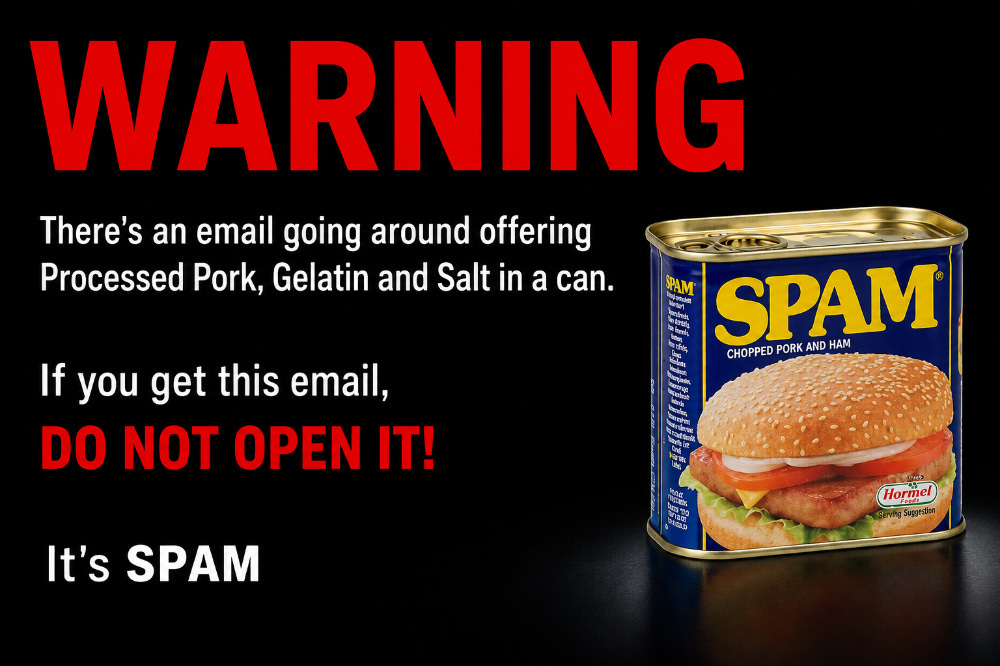
The term spam email comes from a famous 1970 Monty Python’s Flying Circus sketch where the word “Spam” (the canned meat) is repeated over and over until it drowns out all conversation. Internet users later adopted “spam” to mean unwanted messages that flood a discussion or inbox.
The term “ham” was created much later by email filtering developers as a humorous opposite of spam. Since Spam is a meat product made from pork and ham, they chose ham to mean legitimate, wanted email.
In email filtering:
Spam = unwanted email
Ham = wanted, legitimate email
The term “ham” appears to have been popularised by the Spam Bayes email filtering project around 2001.
So the sequence was:
Spam (the canned meat)
Monty Python’s repetitive “Spam” sketch
Unwanted internet messages called “spam”
Legitimate email jokingly called “ham” as the opposite of spam
A bit of programmer humour that stuck.
THE DIFFERENCE? Who is doing the thinking.
One of the best AI in education research papers I’ve read found something surprising.
The Three Jobs of Teaching a Child to Read and where AI Fits In
AI helped children understand stories when it asked them thoughtful questions.
But when students asked AI questions and AI simply supplied the answers, they learned less than students who just took notes.
THE DIFFERENCE?
Who was doing the thinking.
AI shouldn’t replace a learner’s thinking.
AI should provoke it.
That’s why my Amazing Stories books don’t end with the story. They begin with children creating, imagining and designing their own ideas using AI as a creative tool.
The person asking the questions isn’t the one learning.
The person doing the thinking is.
After sharing What a Disaster! with a year 2 class, the children didn’t just talk about disasters. They created their own, here’s one of the videos.
BUSTING AI MYTHS, one myth at a time.
Myth 1: “AI doesn’t produce anything original.”
I hear this a lot from kids, often repeated from conversations at home.The genie is out of the bottle. Better to understand AI than remain ignorant about it.
I read my book UnLIKELY and we discussed the illustrations.
Every image in the book was prompted by me and had never existed before.
AI recombined elements from my prompts into entirely new images.
It’s really no different from writing.
Stories use words and letters that already exist.
We simply combine them in new ways to create something original.
They were till not convinced!
We fired up reve.com one of my favourite text-to-image demos(lots of free tokens).
A student suggested:
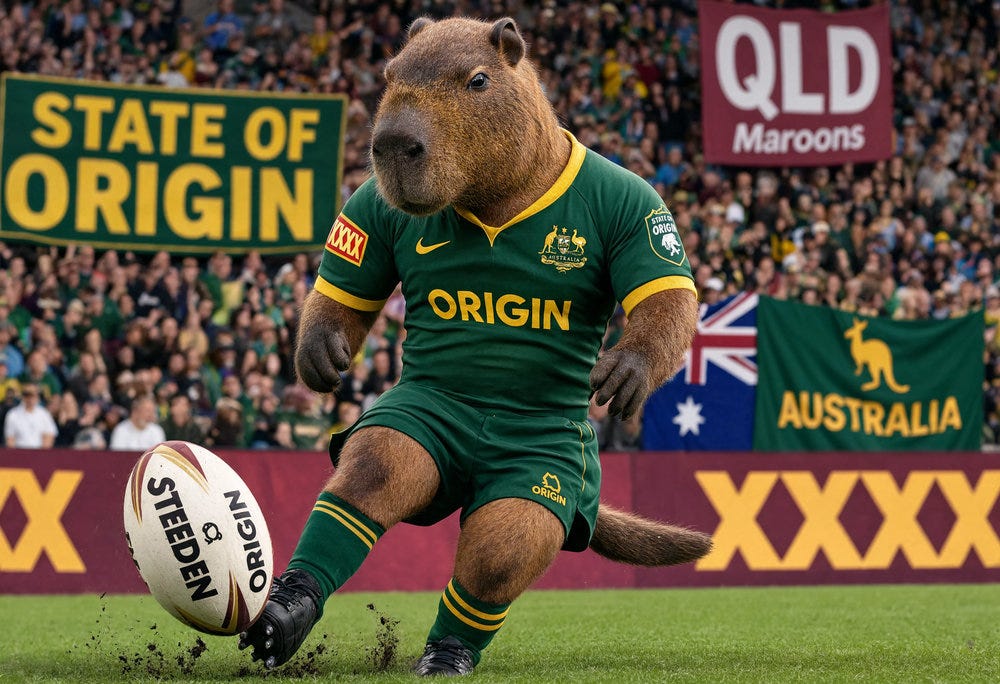
“A capybara playing State of Origin.”
(I’d never even heard of a capybara. The kids knew it was the world’s largest rodent.)
I asked: ”Do you think this image has ever existed before?”
“Nope. That could never happen,” they said.
I pressed GENERATE.
There it was.
An image that had never been seen before, created by recombining elements from the prompt into something entirely new.
MYTH DISPELLED by a demo and a child’s prompt.
AUSTRALIAN’S SCHOOLS ARE FAILING
This is an Excellent presentation from Dr Bella d’Abrera
What particularly resonated with me was Bella d’Abrera’s question:
What is the purpose of education?
After more than 30 years as a classroom teacher, learning designer and educational researcher, I believe I’ve developed a practical answer, not just a critique.
The purpose of education is to develop HUMAN CAPABILITY.
Knowledge → Curiosity → Interests → Exploration → Agency → Human Capability
KNOWLEDGE IS THE FOUNDATION, NOT THE DESTINATION.
Strong knowledge should ignite curiosity, curiosity should lead to genuine interests, interests to exploration, exploration to agency, and agency to expanding what young people are capable of discovering, creating and contributing.
I also believe one of the best ways to depoliticise education is to stop telling students what they should think and instead equip them to investigate the world for themselves.
Build strong knowledge, teach students how to think rather than what to think, then give them the freedom to pursue meaningful interests, test ideas, solve real problems and arrive at their own informed conclusions. Students should leave school not as political activists of any persuasion, but as knowledgeable, capable, curious and independent thinkers.
I’ve spent years designing, implementing and refining practical classroom models that do exactly this. They increase engagement, strengthen knowledge and develop genuine student agency.
The conversation now needs to move beyond diagnosing what’s wrong with education to demonstrating what works.
START with ONE lesson.
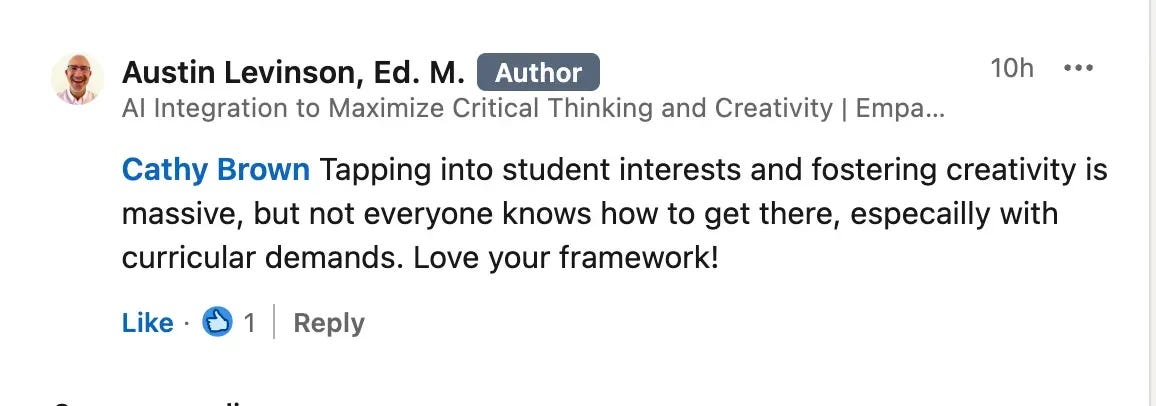
This was one of the responses to my recent article on My School of the Future it sums up the challenge perfectly:
THAT’S A FAIR POINT.
It’s easy to talk about developing autonomous learners. It’s much harder to show what it looks like in a real classroom while still meeting curriculum outcomes.
So….
HERE’S A PLACE TO START
Don’t redesign the whole school.
Start with one lesson.
The goal is not just to cover content.
The goal is to use content to develop AUTONOMOUS LEARNERS.
I recently worked with a class using my book What a Disaster!
We began together. I read the story aloud and we discussed disasters from the book, disasters students had experienced and disasters they could imagine. Students then used Flow Writing to write continuously for five minutes about a disaster.
Up to this point, I was leading the learning.
Then I gradually released control.
Students worked in pairs to turn their stories into ScratchJr animations.
I didn’t demonstrate ScratchJr.
I didn’t provide a PowerPoint.
I didn’t hand out step-by-step instructions.
Instead I simply challenged them:
“See what you can discover.”
Students explored the interface, watched the built-in video, read the help pages and experimented.
Very quickly the classroom filled with questions:
How do I add a photograph as a background?
Can I make a ghost sprite?
Can my characters talk?
How do I make something invisible?
How do I create speech bubbles?
Can I change the sprite colours?
Notice something important.
These weren’t teacher questions.
They were student questions.
Every question came from the students.
My role changed.
I wasn’t delivering instructions.
I was coaching, encouraging, asking questions, suggesting possibilities and helping when students became stuck.
Some students discovered loops instead of repeating code blocks.
Some chose to generate AI backgrounds.
Some helped other groups solve problems.
The classroom became a community of learners rather than a class waiting for instructions.
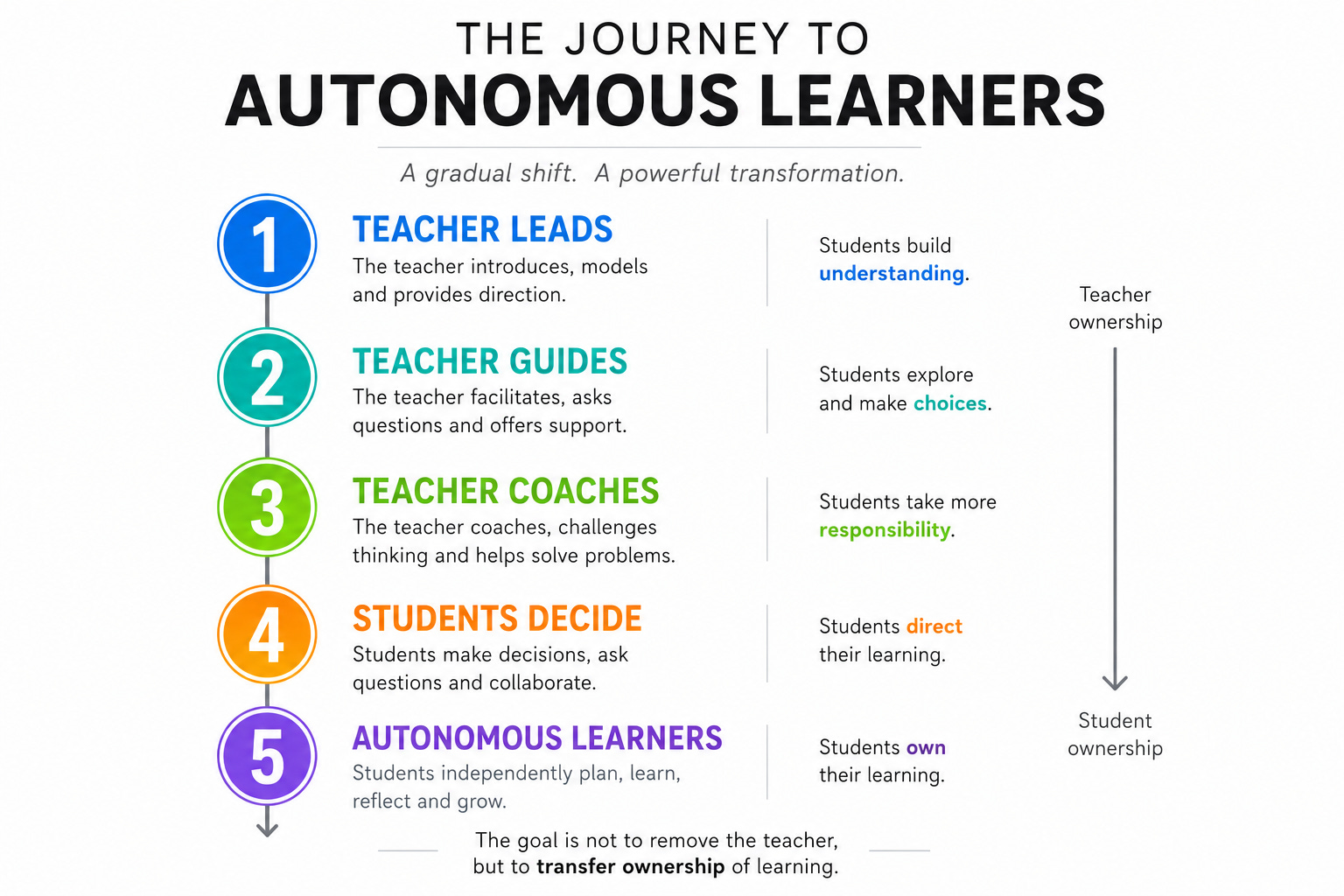
This is how autonomous learners are developed.
Not by removing the teacher.
By gradually transferring ownership of the learning from teacher to student.
Start with one lesson.
Then another.
Small changes.
Big difference.
Autonomy isn’t leaving students alone. It’s gradually transferring responsibility from teacher to learner.
CHECK THESE OUT LIST
A selection of NLRAI resources for kids to use, FREE no login required.
SAY What You See Learn the art of image prompting with the help of Google AI.
BLOG Opera Experiment with different pitches & different voices.take the blobs on a tour around the world. Here’s the Lesson Plan for it as well.
SONG Maker To make a song, add notes by clicking the grid.
VIOLA the Bird a great way for anyone to learn about string instruments & to explore their own creativity through music. The world’s first “bird-tuoso”.
VT YOUTUBE

If you’d like to see what autonomous learning looks like in a real classroom, I’ve just added two new videos to my YouTube channel.
After reading A New Jumper, Kindergarten students created their own stories in Book Creator.
After reading What a Disaster!, Year 2 students invented and animated their own disasters in ScratchJr.
The story is only the beginning.
If you’re interested in how AI, creativity and children’s agency can work together, I’d love you to subscribe to my YouTube channel and follow the journey.

This Newsletter is not free, despite the misleading advertising above.
The Fee is now due. Each week you must help one colleague AI & technology who has less knowledge than you. HELP THAT PERSON even if you have to visit their classroom or do a little research and get back to them. Trust me, this will help a lot of people get their computer classrooms running better. OK I'm trusting you!!!
Editor: Cathy Brown cathy@virtualteacher.com.au
Before you go I have a question for you:
Would you be interested in learning more about AI and how to integrate into your teaching? Would you like more information about inservice and training?
No need to decide just yet, just email me if you'd like to start the ball rolling. cathy@virtualteacher.com.au or check out the VT AI Consultancy Page.