

AI the Force Multiplier for CREATIVITY
VT No 310
Welcome Everyone,
Sometimes the most powerful question you can ask a child is:
“What do YOU like?”
NOT: “What should everyone learn at the same pace?”
NOT: “What worksheet are we all doing today?”
Real engagement starts with curiosity, passion and agency.
That’s one reason I wrote What Do YOU Like?
The discussions it sparks with children are incredible.
CHECK OUT the new trailer below.
ENJOY, ENJOY, ENJOY!
Have as Much FUN as possible!
Find What YOU Like and do more of it.
Enough of the chat, check out the Amazing Tools & Absolutely Splendid ideas
I have to share with you in this issue, in the spirit of
EASIER, MORE PRODUCTIVE
& A WHOLE LOT MORE FUN!
Until Next Time…
PS
Virtual Teacher is.......... FREE FOREVER
Here's What's on the MENU Today
Mind Candy - mental treats, do what you love.
HUNTING THE NOT FAIR - I love this little film.
The Meaning of Life Explained by 3rd Graders -This is your life you’re in control.
AI the Force Multiplier for CREATIVITY - It’s not the tool it is how you use it.
How DO you Convince K-3 teachers - ACTUALLY they don’t have to.
TO DO LIST - Make sure you do!
VT YouTube -
Let's create a ripple effect of learning, sharing, and growing together.
Pass any good ideas on to colleagues, and encourage them to subscribe to VirtualTeacher for more.
MIND CANDY
"Teaching children is an accomplishment; getting children excited about learning is an achievement." Robert John Meehan
Some quotes from Seymour Pappert from the 2004 Apple Conference
“You don’t need to budget for PD, in a professional environment Professionals develop.”
“How can we make the magic persist.”
“If we love children and we know what’s possible how can we do anything else.”
“How does a school that has seen the magic turn it’s back on it.”
Amazing man, amazing conference.
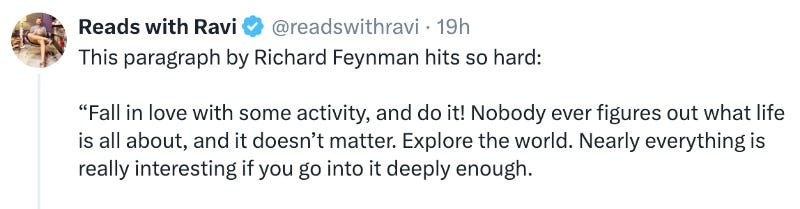
Equity & fairness are impossible. Education’s obsession with equity and fairness sidetracks schools from the real goals that are achievable, building Human Capability.
When the system becomes obsessed with equal outcomes, it creates a platform for excuses.
The better question is not:
“Is this fair for everyone?”
The better question is:
“Is this building Human Capability for this child?”
Steve Jobs touched the heart of this in his 2005 Stanford Address:
“The only way to do great work is to love what you do.”
That changes everything.
Because once a child finds something they genuinely care about, effort changes.
Persistence changes.
Learning changes.
You stop needing to force motivation because purpose drives it.
Great education is not about manufacturing identical students.
It’s about helping individuals discover what they love enough to become capable, driven and extraordinary in their own way.
The only way to do great work is to love what you do find what you love.
Steve Jobs 2005 Stanford Address covers this brilliantly
HUNTING THE NOT FAIR
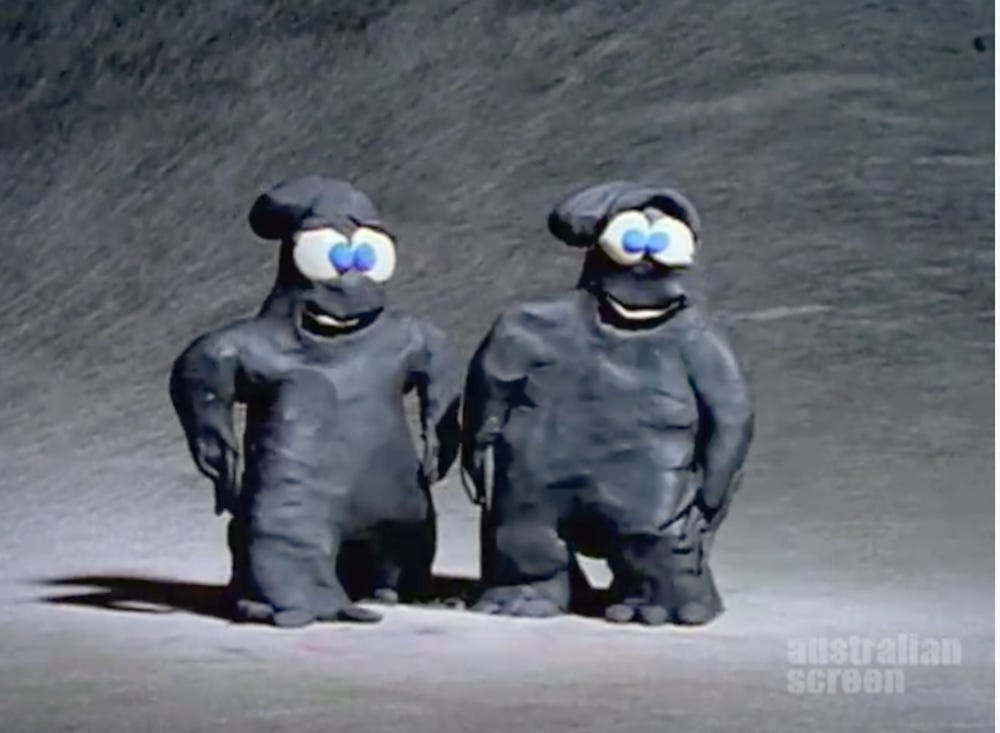
I love this little film and often use it when kids say
“It’s not FAIR”
THE TRUTH - Life isn’t fair!
WATCH the Story of Young Billy Blair - Hunting the Not Fair
Fabulous clay animation.
“Tell me have you ever seen the NOT FAIR?
Is it long like a dragon or big like a bear?
Do they come in the singular or perhaps in a pair?”
You will love it too!
The Meaning of Life Explained by 3rd Graders.
This is your life you're in control. Give kids the agency they need to do this.
Ask them "What do You Like?" right from the start.
Still not seeing enough evidence that AI can create high level thinkers. Maybe you think it is too soon and technology only works when it's implemented perfectly.
Still unsure if you should implement AI.
I think this recent paper explains the issue quite well, it is true for higher education as well as ALL Education not just AI Education:
“The cognitive impact of ChatGPT in higher education”
The study does NOT say ChatGPT magically creates high level thinkers.
What it says is far more important:
AI can enhance critical thinking when students actively question, evaluate, refine and reflect on outputs.
Passive copy/paste use can reduce cognitive effort.
Which actually reinforces the point:
It’s not the AI itself that determines the outcome.
It’s how the learning culture around it is designed and implemented.
One of the paper’s main conclusions is that the impact of AI is not determined by the technology itself but by the learning design and teaching approach surrounding it. Students who use ChatGPT actively, questioning, evaluating and refining responses, tend to develop stronger cognitive outcomes than students who use it simply to generate answers quickly.
The article ultimately argues that there is a need to shift from simply policing AI use toward teaching AI literacy, critical evaluation, metacognition and responsible integration of AI into learning.
The real question is:
Will schools teach students to use it thoughtfully, critically and creatively, or pretend it isn’t already reshaping how humans access information and solve problems?
It’s not the tool it is how you use it.
How DO you Convince K-3 teachers?
A comment the other day from on my recent post on Human capability.
“Not sure how you’ll convince K-3 teachers that this model is better than explicit instruction of phonics and numeracy skills.”
ACTUALLY you don’t have to.
Explicit teaching has its place.
The real question is:
What happens when curiosity, passion, agency and genuine engagement enter the picture?
THAT’S WHEN LEARNING ESCALATES.
Because suddenly the explicit teaching has somewhere REAL to go.
Mac was interested in Minecraft.
Oliver became obsessed with ninjas.
Alia wanted to dig in the dirt and experiment with mud and water so we built from THAT.
Books.
Writing.
Discussion.
Research.
Movies.
Storytelling.
Collaboration.
Presentation.
Reading with purpose.
The learning takes off because the kids actually CARE.
That’s why I wrote What Do YOU Like?
I even use the yellow glasses from the book. Whoever wears them asks:
“What do YOU like?”Simple question.
MASSIVE SHIFT
And here’s the upside nobody talks about enough:
When kids are genuinely engaged:
• behaviour issues melt away
• reward systems become less necessary
• stickers, stars and constant external motivation lose power
• the classroom becomes more self driven
Because interested kids WANT to learn.
That’s the difference.
Check out What Do YOU Like? To get the ball rolling.
The video and lesson plan are free.
Really - What Do YOU Like?
GREAT feedback for my AI in Education Course.
I have had over 100 comments and 500 participants in the course.
Here are a few of the comments.
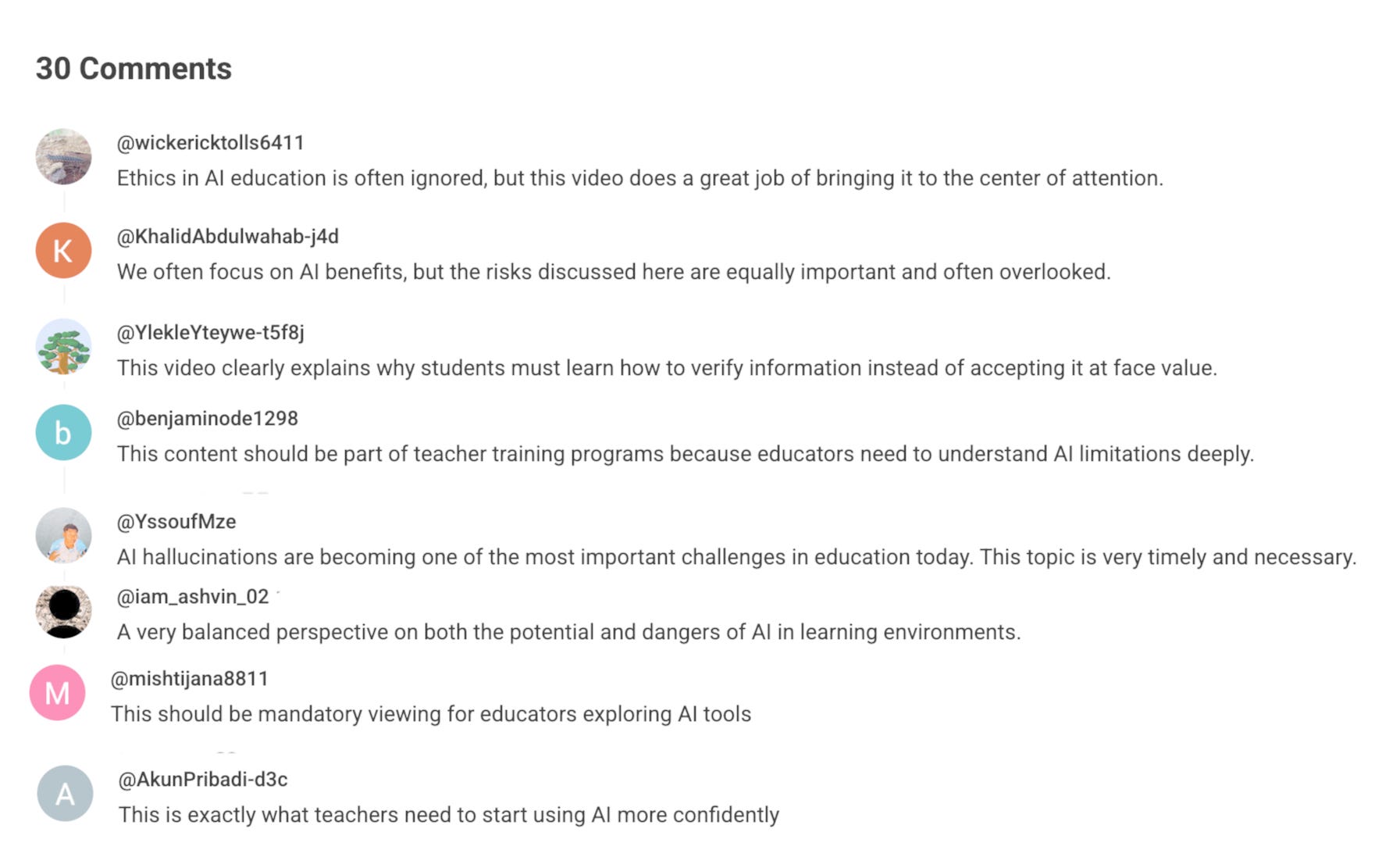
AI in Education Becomes Real When Teachers Actually USE It.
One of the most encouraging things about running this free AI in Education course has been the feedback coming from teachers, educators and viewers around the world.
A lot of people are still talking about AI in theory.
What I’m trying to do is make it practical, understandable and usable in real classrooms NOW.
Some recent comments included:
“This should be mandatory viewing for educators exploring Al tools”
“Helpful content for anyone trying to understand how AI is being used in education today.”
“The step-by-step explanation really makes the topic less intimidating.”
“This video makes it easier to see the real benefits of AI in learning environments.”
“The visuals are clean and the explanation flow is smooth.”
That matters to me because the biggest gap in AI education is no longer technology.
It’s implementation.
The course is completely FREE and I’d genuinely love more feedback from teachers, school leaders, parents and anyone interested in the future of learning.
I’m also available for consultancy, workshops and practical AI implementation support for schools and education organisations looking to move beyond theory into real classroom practice.
AI in Education Course Link 50 lessons, over 10 weeks.
The students laughed like drains!
Recently I was working with a group of Year 5 students.
They had been reading WANDI by Favel Parrett.
I used ChatGPT as a whole class demo. I wanted to use character descriptions to prompt students to create an image generation task. The Fantastic Prompt and Mr Fox is an example, link in first comment.
So I typed:
“Provide a character description of the main character in Wandi by Favel Parrett, for Year 5 students.”
The response was:
“Wandi is an Australian kangaroo with sandy coloured fur that’s soft like a cloud. He has light coloured patches on his face and tummy. His bright, intelligent eyes convey a mix of innocence and determination.”

The students laughed like drains.
ChatGPT was, of course, was completely wrong. Wandi is a dingo.
This was great.
Prompt lesson abandoned, and we discussed what makes a fact a fact.
The students worked in groups discussing this, right when the issue arose.
When they could see the problem and address it themselves.
So where do you start AI discussions with students?
Exactly when you are using it, a PERFECT TEACHING MOMENT.
We discussed:
A lot of people seem to be concerned that AI will give the wrong answers.
What do you think about this?
What is a fact? How do you know if it’s true?
What can you do to verify the information?
Should you believe the answers from an AI?
I’m so glad AI hallucinates and that I can have these discussions about verifying and double checking the output. Not just for AI, but for everything.
CHECK THESE OUT LIST
Dinosaurs - Life styles of the large and Extinct VT page
LLMs are a Dead End - from Kira - A great way to understand what LLMs do and don’t do a must watch 5 minute video. AI has no skin in the game.
Check out all the AMAZING Stories for adventurous minds of all ages…
….with a touch of Money Business
AI or Not? Can you tell the difference between AI-generated images and real images? Download this Free pdf and start the AI or Not discussion.
DAiLY 10 delivers 10 interactive mental maths questions covering number, operations, place value, fractions and problem solving.
VT YOUTUBE

Use AI to Learn AI — Getting to Know the Interface (EduChat Demo for Students) this is a great video to get started with AI and use it to learn about AI. Encourage open-ended questions — “What happens if...?” or “How could we...?” — to inspire curiosity and deeper thinking.

This Newsletter is not free, despite the misleading advertising above.
The Fee is now due. Each week you must help one colleague AI & technology who has less knowledge than you. HELP THAT PERSON even if you have to visit their classroom or do a little research and get back to them. Trust me, this will help a lot of people get their computer classrooms running better. OK I'm trusting you!!!
Editor: Cathy Brown cathy@virtualteacher.com.au
Before you go I have a question for you:
Would you be interested in learning more about AI and how to integrate into your teaching? Would you like more information about inservice and training?
No need to decide just yet, just email me if you'd like to start the ball rolling. cathy@virtualteacher.com.au or check out the VT AI Consultancy Page.